What Fear Looks Like in the Brain — and Why It Matters for Water Safety
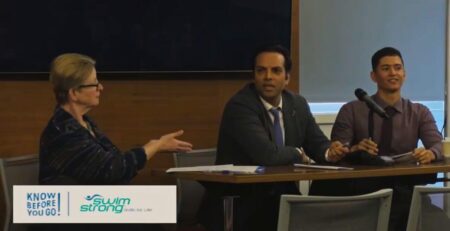
When Dr. Sudhir Gadh, MD, took the microphone at Swim Strong Foundation’s 15th anniversary celebration, he did something most people in the water safety space don’t do: he explained exactly what happens inside your skull when you’re afraid of the water.
Dr. Gadh is a board-certified psychiatrist and U.S. Navy Commander based in New York City, specializing in trauma, addiction, and the intersection of mental and physical health. He’s also a recurring voice in Swim Strong’s community conversations — because he understands that for many people, the barrier to learning to swim isn’t access. It’s the brain.
“I’d like to address it to brain body,” he told the room, “because what fear looks like in the brain is an electrical traffic jam.”
That’s not a metaphor. That’s neuroscience.
The brain operates through an almost infinite web of electrical pathways. When you experience something traumatic — or when fear is passed to you through your environment, your family, your community’s history — it lodges in two small almond-shaped clusters of neural nuclei called the amygdala, located deep in the center of the brain. When the amygdala is activated, everything wired for fight-or-flight turns on. You freeze. You become hypervigilant. And the key thing Dr. Gadh wants people to understand is that it stays on. Trauma doesn’t just visit. It moves in.
For communities that have experienced generational exclusion from pools, beaches, and aquatic spaces — exclusion that in the United States was literal and enforced — this means that fear of water isn’t simply a personal quirk. It’s a neurological inheritance. Dr. Gadh was direct about his own experience: “It was in my brain, put into me by my mother, who still can’t swim.” He didn’t say that to diminish his mother. He said it to name the mechanism. And to name it is to begin loosening it.
What does loosening look like? Dr. Gadh’s approach, both clinically and in community conversations, is to reframe the goal. Rather than leading with what people will avoid — drowning, injury, death — he leads with what they stand to gain. The sense of smell that returns when someone stops smoking. The bank account that grows. The overall improvement in how life feels. Applied to swimming, the logic is the same: you’re not just reducing your risk of a fatality. You’re opening up a part of living you’ve been kept from.
“You could start really living,” he said. “It is a lot of fun to be able to swim.”
That framing matters enormously for what Swim Strong Foundation does. Our Know Before You Go!® curriculum isn’t designed just to warn people away from danger. It’s designed to give people the situational knowledge they need to actually engage with water — to read it, assess it, understand it — so that the environment stops being a threat that triggers the amygdala and starts being something navigable. Something knowable. The traffic jam begins to clear when knowledge replaces the unknown.
Dr. Gadh also raised a statistic that captures the scale of the challenge: roughly 60% of white children know how to swim compared to roughly 30% of Black children. Not because of biology. Because of history. Because of the decades of deliberate exclusion from pools, the closed YMCAs and segregated beaches, the cultural transmission of “we don’t do that” — all of which shaped the amygdala responses of parents who then shaped the environments of their children.
Understanding this is why Swim Strong addresses situational knowledge of water in addition to swim lessons. It is, in the deepest sense, a public health intervention. When a child learns to swim here and carries that capability into adulthood, they will hold their own child’s hand at the water’s edge a little differently. The electrical traffic jam eases. The pathway opens. And as Dr. Gadh put it, the work ripples outward — from water, to the air, to the metaphorical elevation of a life.
Watch Dr. Gadh’s full remarks in our 15th anniversary video on YouTube. The conversation is as relevant today as the day it was recorded.📺