Take the Doughnut, Story 2: What Diving Can Teach Us About Getting Into the Water in the First Place
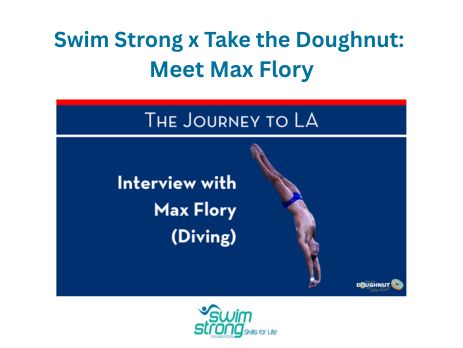
Last time on *Take the Doughnut*, we talked about going after what you want — Melissa Forziat’s whole philosophy of carpe diem, chasing it down one decision at a time. This installment picks that thread back up with diver Max Flory, who’s currently packing boxes for a cross-country move to train for a shot at LA. But the more interesting part of his story, for us, isn’t the move itself. It’s everything that had to happen before Max ever stood on a diving board — and everything that has to happen before anyone else does too.
The sport nobody sees until it’s on TV every four years
Max said something in his interview that’s worth sitting with: diving is one of the most-watched sports during the Olympics, and one of the least-watched sports between them. Outside of the Games, if you want to catch a competition, you’re “watching weird websites and getting a VPN,” as he put it. There’s no easy front door. That’s a pattern worth naming, because it’s the same pattern that shows up around water more broadly. A lot of people only think about water safety when something dramatic puts it in front of them — a headline, a summer news cycle, a scary story. The rest of the year, the on-ramp just isn’t there. Nobody hands you the front door. Diving needs a better front door. So does situational knowledge of water. Both get treated like specialist knowledge instead of something everyone gets an invitation to.
Every diver starts as a swimmer
Here’s the part of Max’s story that matters most for this series: he didn’t start as a diver. He started as a six-year-old in swim lessons at a neighborhood summer pool in Fairfax, Virginia, who kept eyeing the dive team practicing next door. He asked his mom if he could swap swim lessons for diving lessons — and that’s the whole origin story of an athlete who went on to compete for Team USA. Every single sport that happens *in* water — diving, water polo, synchronized swimming, surfing, even the just-for-fun stuff like snorkeling on vacation — sits on top of the same foundation: being genuinely comfortable and confident in the water first. You can’t take the doughnut on the diving board if you never took the doughnut in the shallow end. That’s the case for building situational knowledge of water early and well. It’s not the finish line. It’s the launchpad for every water-based thing a person might want to go do with their life — from Olympic diving to simply not being nervous on a boat.
Safety isn’t a footnote — it’s the whole architecture
The other thing Max talked about at length was safety, and it’s a genuinely instructive model. Elite diving programs don’t just tell a young athlete “be careful.” They build layered systems so a person can attempt something hard without betting their body on the first try:
- Dryland training — gymnastics-style work on crash mats and foam pits, so a diver can rehearse the shape of a dive with zero water involved.
- Harness rigs, both on land and directly over the pool, so a coach can physically support a diver through a new skill while their body learns the spatial awareness the dive requires.
- Bubble systems at the bottom of the pool that break the water’s surface tension, softening what happens if a landing goes wrong.
- Coaching progression — even without fancy equipment, a good coach advances a swimmer at a pace that matches what their body and confidence can actually handle.
Notice what all four of those have in common: none of them are about avoiding water. They’re about making it safe to try. That’s the same spirit behind situational knowledge of water — not fear of the water, not staying away from it, but building the layered awareness that lets someone move through it with confidence instead of hesitation.
Growing up as an athlete means more than getting better at the sport
Max didn’t stop at competing. About a year ago he started Diving Mentoring, working one-on-one with young divers on everything that goes into performance beyond the physical dive itself — the mental side, the fear, the blocks that stop an athlete from progressing even when their body is ready. That program is really an answer to a question every serious young athlete eventually runs into: what do I do with all of this once the medals and rankings stop being the whole story? His advice for getting there is simple to say and hard to live: always find a way to get better. Injuries happen. You’ll miss a team. You’ll have to sit out. In those moments it’s tempting to just mope — but there’s always something you can work on that pays off later. That’s not sport-specific advice. That’s how anyone matures past being good at one thing into being someone who can put a whole life together for themselves. It’s also worth noticing where that program came from. Max spent nineteen years accumulating tools — physical, mental, tactical — one coach and one hard season at a time. Once he had them, his instinct wasn’t to keep them to himself. It was to find the next generation of divers and hand the tools down faster than he got them. That’s the real throughline of his advice: build the skills, then go find the people who need what took you years to learn, and give it back to them.
Why this belongs in a swim story
Max is headed to Mission Viejo to train alongside his synchronized-diving partner, chasing a real shot at the next Olympic cycle. That’s an athlete’s story. But underneath it is a much more universal one: a kid who learned to swim, fell in love with what was possible once he could, and spent the next nineteen years finding out how far that could go. That’s really the whole pitch of this series. Getting comfortable in the water isn’t the end of anyone’s story — it’s the opening move. Diving boards, boats, oceans, rivers, pool decks with your kids on a Saturday: all of it opens up once the water itself stops being the obstacle. Whether you’re six years old eyeing a dive team through a fence, a parent deciding what to sign your kid up for this summer, or an adult who never quite got comfortable in the water and wonders if it’s too late — Max’s journey is a case for starting anyway, and for finding the people further down the road who are willing to hand you what took them years to learn. That’s what makes this one worth watching at any age: not just for the diving, but for what it takes to keep water — and the sports and safety that come with it — a genuine part of your life for the long haul. So take the doughnut. Get in the water. See where it takes you.
Follow Max Flory’s journey to LA on Instagram @MaxFlory, and his mentoring program at @DivingMentoring.
Follow Melissa Forziat’s and her show on Instagram @melissaforz, Facebook @Melissa Forziat, Keynote Speaker and her Youtube Channel Melissa Forziat, Take the Doughnut Keynote Speaker.