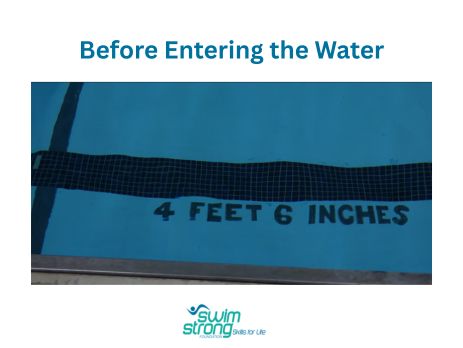
Before Entering the Water
At Swim Strong Foundation, the first thing a new student learns isn’t a stroke. It’s the pool itself. That’s by design. Before anyone steps into the water, Founder & Executive Director Shawn Slevin leads every new group through a hands-on orientation — walking the deck, reading the depth markers, and building an understanding of the space before a single lesson begins. It’s a small shift in sequence that reflects something much bigger about how SSF thinks about teaching people to be safe and confident around water.
Knowledge First, Then Skill
Swim Strong Foundation’s approach rests on two pillars: situational knowledge of water, and skilled swim instruction. Coach Shawn’s orientation is where those two pillars meet for the very first time. Long before a student learns to float or kick, they learn to read a pool — to notice that its “footprint,” the shape of the floor beneath the surface, doesn’t always match what it looks like from the deck. They learn to locate the depth remove-change markers. They learn that many pools have more deep water than shallow, and that assuming otherwise is exactly the kind of habit Know Before You Go!® is built to replace with something more reliable: looking, checking, and knowing. It’s a habit that travels. A student who learns to walk a pool deck and locate its depth markers is building the same instinct they’ll use one day wading into a lake, a pond, or the ocean — checking the ground beneath them step by step instead of assuming it. That’s the foundation of everything SSF teaches: situational knowledge that holds up anywhere you find water.
The Body Learns Differently in Water — So Teach It That Way
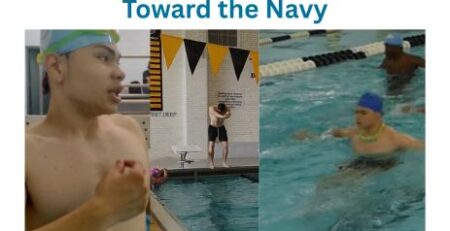
Part of what makes Coach Shawn’s orientation distinctive is how much of it happens before anyone gets wet. On dry land, she walks students through the two things that change the moment they enter the water: how they breathe, and how they move. On land, we drive off our knees. In the water, that same instinct pushes a swimmer down instead of forward — so orientation reframes the whole mechanic around the hips, with students practicing a forward lean and a hip-driven step along the deck before they ever try it in the pool. Breathing gets the same treatment: out of the water, many of us breathe through the nose; in the water, we take are in through the mouth and exhale out via the nose. It’s a small shift, but naming it early — and letting students physically feel the difference, by placing their hand under nose, before they’re in the water — turns a confusing instinct into a plannable skill. Even the core-strengthening drill Coach Shawn demonstrates on the deck does double duty: it builds the same muscles that support a swimmer’s breath control, and it’s simple enough that a student can keep practicing it at home, long after the lesson ends.
A Culture of Checking In
Maybe the most telling part of the orientation isn’t physical at all. Before anyone gets in the water, Coach Shawn introduces the group to a shared language for checking in — with instructors, and with each other. Students learn to say plainly how they’re doing, and they’re just as encouraged to ask a neighbor the same question. Instructors are easy to spot by their white caps, so help is never more than a glance away. The philosophy behind it is simple, and Coach Shawn says it directly to every group: get in front of a situation before it becomes one. It’s a quiet kind of safety culture — built on noticing, not fear — and it sets the tone for everything that follows in the water.
Twenty Years of Starting the Same Way
As Swim Strong Foundation marks its 20th anniversary in 2026, having reached more than 135,000 students through its educational programming Know Before You Go!®, taught over 12,600 people to swim, graduated 585+ lifeguards, and delivered more than $2.4 million in free lessons, it’s worth noticing what hasn’t changed: every single one of those students started the same way Coach Shawn’s newest students do — on the deck, before getting into the water, learning to read the space they’re about to enter. It’s a small piece of the curriculum in terms of minutes. But it’s where SSF’s entire philosophy — knowledge before skill, empowerment instead of fear — actually begins.