Revisiting a Powerful Conversation for Black History Month | Full SJU Panel + Screening of “A Film Called Blacks Can’t Swim”
Revisiting a Powerful Conversation for Black History Month | Full SJU Panel + Screening of “A Film Called Blacks Can’t Swim”
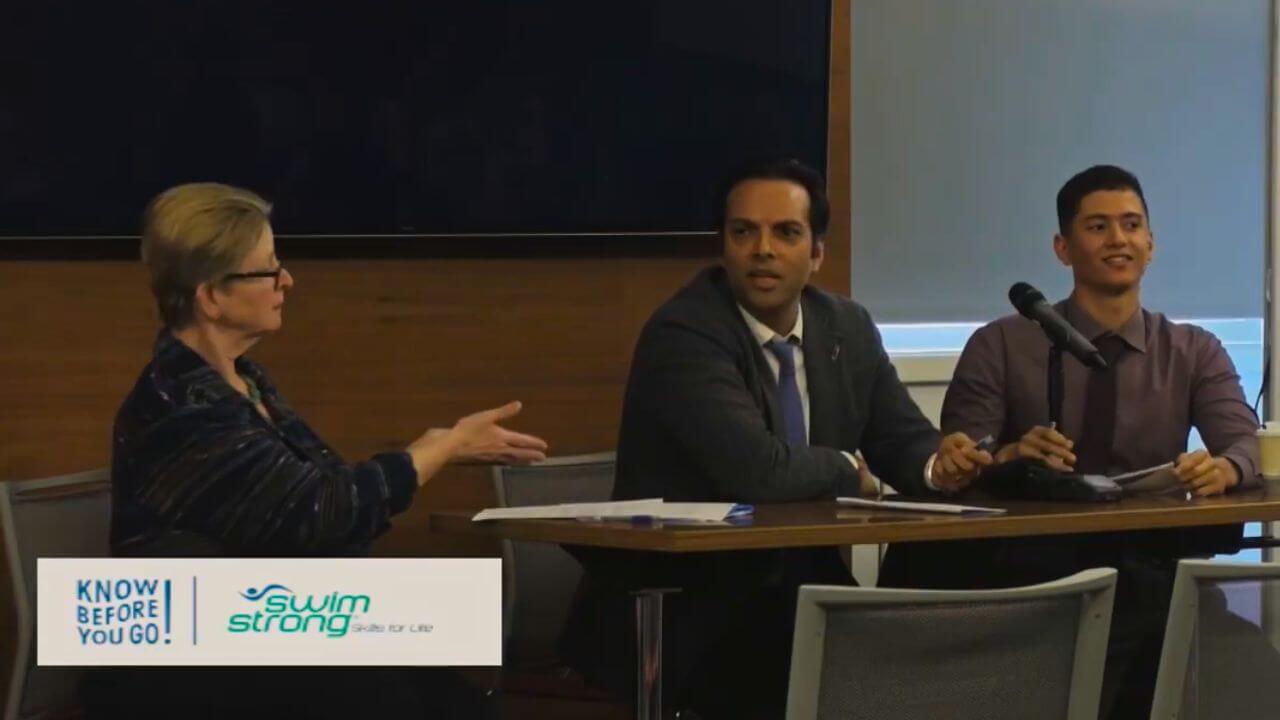
This Black History Month, we’re going back to a conversation that stayed with us — a panel discussion hosted at Saint John’s University that brought together our founder Shawn Slevin, board-certified psychiatrist and U.S. Navy Commander Dr. Sudhir Gadh, and Dominican Republic 2016 Rio Olympian Jhonny José Pérez Peña for a screening of A Film Called Blacks Can’t Swim.
We’ve revisited this video with improved audio so more of you can access the full conversation — and what strikes us watching it again is how much of the discussion goes beyond swimming. It’s really about what we know before we ever reach the water.
The Psychology of Not Knowing
Dr. Gadh introduced a concept that’s stayed with us: epigenetics. The idea that fear isn’t just learned — it can be passed from generation to generation at a biological level. A grandparent who never swam doesn’t just model avoidance. That fear gets transmitted, quietly, across decades. The clutched hand at the sight of a pool. The reflexive “we don’t do that.” The silence where water safety education should be.
This is what intergenerational water risk actually looks like. It isn’t just about who has access to a pool. It’s about what knowledge — and what fear — travels through families over time.
And the roots, Dr. Gadh reminded us, are historical. During enslavement, keeping Black people away from water was a tool of control. A person who can’t swim can’t escape. What began as deliberate subjugation calcified into cultural patterns that outlasted the laws that created them. Understanding where a fear comes from is the first step to dismantling it.
Situational Knowledge of Water as the Missing Piece
Jhonny’s story — growing up on an island nation surrounded by water, with fewer than 20 swimming pools for 10 million people — illustrates the cruel paradox of aquatic risk in many communities. Proximity to water does not equal knowledge of water. In the Dominican Republic, in Far Rockaway, in neighborhoods across this city, people live beside rivers, beaches, and bays without anyone ever explaining what makes open water different from a pool, what a rip current feels like before you’re in one, or why the ocean in October after a distant hurricane is a completely different environment than the ocean in July.
That’s what our Know Before You Go!® curriculum is designed to address. Not just swimming — situational knowledge of water. The ability to read a body of water, assess the risk, and make a decision before you’re in danger. Because as Shawn said in that room: nobody goes to the water expecting a bad outcome. Those three boys at the Rockaways that October didn’t know what they were walking into. And that’s the gap we’re working to close.
What Breaks the Cycle
The most hopeful thread running through the entire panel is a simple one: knowledge breaks cycles. Jhonny taught himself to swim against his family’s wishes, watched Michael Phelps on television, and competed at the Olympics. One of his friends — a kid who sometimes didn’t have food at home — started swimming, started traveling, and ended up pursuing a college degree. Not in spite of the water. Because of it.
Dr. Gadh put it plainly: when you teach a child to swim, you loosen the grip. The next generation holds their child’s hand a little less tightly at the water’s edge. Multiply that across a community, across a generation, and you begin to see how water safety education is community health work.
Why We’re Sharing This Now
Now in our 20th year (with our anniversary on July 6), Swim Strong Foundation has taught more than 12,400 people swimming skills across five NYC locations. We’ve graduated more than 535 lifeguards. We’ve helped 68 young men and women meet Navy, Coast Guard, and Marine Corps swim requirements so they could serve their country. And 51 of our alumni went on to become first responders right here in New York City — NYPD, FDNY, and EMT. We’ve brought Know Before You Go!® to 105,500 students and 3,500 adults who learned to read a water environment, not just a pool lane.
But the conversation from that Saint John’s panel reminds us that the work is never just technical. It is psychological. It is historical. It is cultural. And it is absolutely urgent.
Watch the full panel on our YouTube channel. The conversation is more relevant today than when it was recorded.